
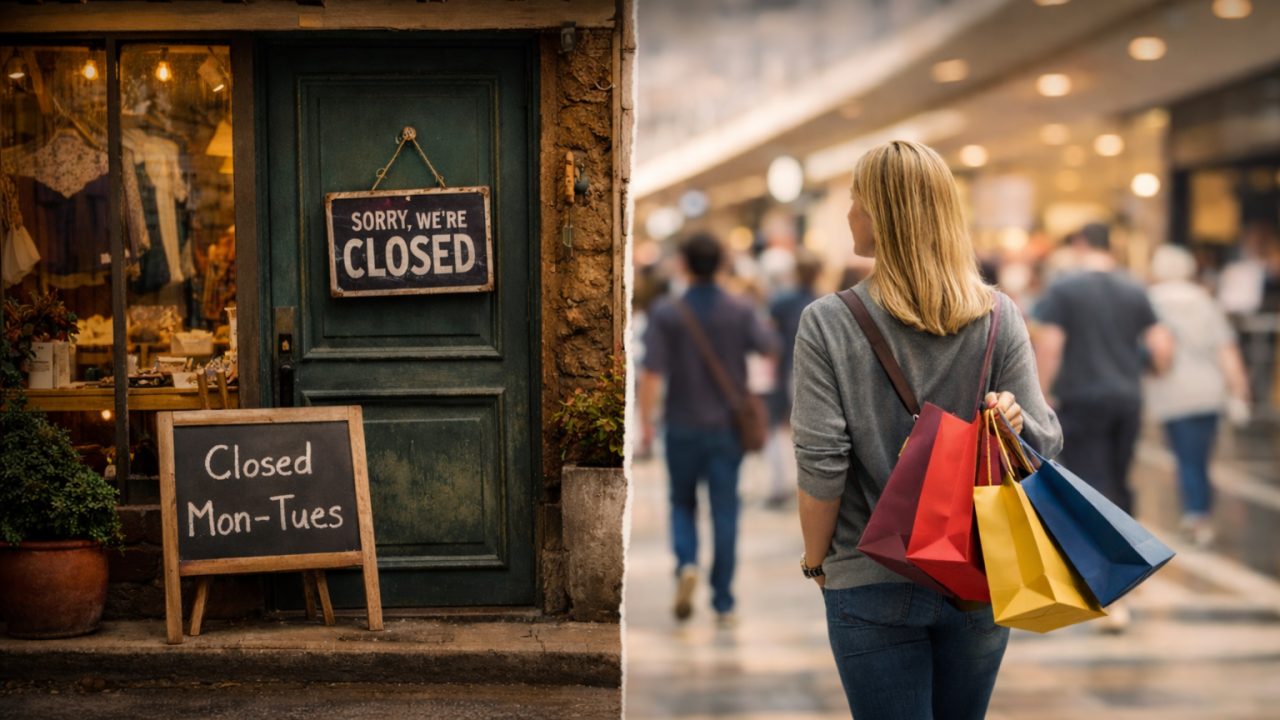
Recently, a local consumer sent us a private message expressing frustration with the messaging to shop small. Winter weather had led to closures around Small Business Saturday, which she understood. What felt harder to reconcile was that when she wanted to shop small during the week, many local stores were closed.
She travels through multiple towns Monday through Wednesday and genuinely wants to support local businesses, but often finds shops closed during those hours. Her question was straightforward: are small businesses saving money by closing during the week, or losing sales? And if sales are the goal, should they be open more?
They are not wrong.
Shopping small is not always convenient. Missed opportunities are frustrating, especially when someone genuinely wants to support local businesses and cannot.
That frustration is real. And it is also a signal.
What often goes unseen
Many small retailers are run by one person, or maybe a very small team. Weekday closures are rarely about avoiding customers. They are often the only time available to restock inventory, manage bookkeeping, handle marketing, take care of family responsibilities, or simply recover (we all need time off).
Burnout is real in small business. Margins are thin. Time is limited.
When early snow hit this year, it caught many communities off guard. Fewer shoppers, unexpected closures, and suddenly business owners were making pleas for support out of uncertainty and concern.
That context matters.
Why one store opening does not fix the problem
There is another piece people outside small towns may not realize.
One business opening on a block where everything else is closed rarely works. Most shoppers will not park, walk in, and browse when the surrounding district is quiet. It is similar to walking into a mall where only one store is open. People tend to go somewhere else.
That is why many towns align on shared days off. Mondays and Tuesdays often have the lowest foot traffic. This is not about lack of effort. It is about survival in a system that was never designed for modern buying habits.
This is not an hours problem. It is an ecosystem problem.
The question is not whether a shop should open one more day each week. It is why individual business owners are expected to carry the full weight of convenience, visibility, and access on their own.
Consumer expectations are shaped by platforms built for scale and always-on availability. Small businesses, by contrast, are operating with limited time, staffing, and infrastructure, often without shared systems to support them.
If we want shopping small to be easier, the answer cannot simply be longer hours. It requires better infrastructure around small businesses. Clearer visibility into what is available. Ways to connect even when doors are closed. And coordination across towns, districts, and the organizations that serve them.
Where this leaves us
Consumer frustration is not the enemy of small business. It is feedback.
And small business owners are not failing consumers. They are operating inside constraints most people never see.
Bridging that gap is the real work.
If we want small businesses to thrive, the solution is not guilt, blame, or longer hours. It is smarter systems that respect both the shopper and the shop owner.
That is the conversation worth having.